
What Baltimore HVAC Shops Do About Calls That Come In at 9pm
Quick answer: Most after-hours HVAC calls in Baltimore are decided before you wake up. The homeowner calls two or three shops in a row, and the first one that responds usually gets the job. You have three options: pay a live answering service, set up an automatic text reply, or let voicemail handle it. Only the first two actually keep you in the running.
The 9pm call is worth more than the 9am one
A homeowner in Parkville whose heat pump quits on a Tuesday night is not going to wait until business hours. They are cold, they are annoyed, and they have a phone in their hand. They will call the first shop they find, then the second, then the third, and they will stop calling as soon as somebody picks up or texts back.
That is the whole contest. Harvard Business Review looked at how 2,241 companies handled inbound leads and found that 23% never responded at all, and that among those who did, the average response took 42 hours. The number worth writing down is this one: the odds of actually connecting with a lead were 60 times higher when a company responded within an hour instead of waiting 24 (Harvard Business Review).
That study was about online leads, not emergency HVAC calls. The gap is almost certainly wider for a homeowner with no heat, because the urgency is real and the alternatives are one tap away.
So the 9pm call is not a nuisance version of a daytime call. It is the call with the least competition and the shortest window, and most shops route it straight to a voicemail box that nobody checks until morning.
Why this bites harder in Baltimore than it looks
Three things stack up here.
The housing stock is old. Anyone working in Hampden, Dundalk, or the older parts of Towson knows the pattern already. Systems that were retrofitted into houses built for radiators fail in ways that do not wait politely for Wednesday.
The weather is bimodal. Baltimore gets a brutal week in July and a brutal week in January, and both of them produce a flood of calls compressed into a couple of days. Your capacity does not change during those weeks. The call volume triples. Whatever leaks in your intake process on a normal Tuesday becomes the main story during a heat wave.
You are not the only one they called. This is the part owners underrate. When you return a voicemail at 7:30 the next morning and the homeowner says they already got someone out, that is not bad luck. That is the predictable result of being third in a race that was decided at 9:15 the night before.
The three ways shops actually handle it
There are only three, and it is worth being honest about the tradeoffs.
Voicemail. Free. Also the option where you lose most of those calls, for the reasons above. Some shops make this work by checking messages at 6am and calling back before the homeowner has started their day. That is a real strategy and it does recover some jobs. It recovers none of the ones where somebody else answered at 9:20.
A live answering service. A human picks up, takes a message, and either dispatches or schedules. This is the best experience for the caller, full stop. It also costs somewhere between a few hundred and a couple thousand a month depending on volume, and quality varies a lot. If the service does not know your dispatch rules, you get woken up for things that could have waited and not woken up for things that could not.
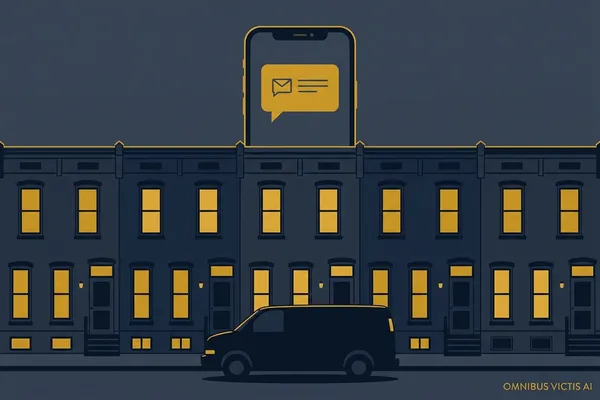
An automatic text reply. The moment a call goes unanswered, the caller gets a text. Something plain: we saw you called, we are closed until 7am, reply here if this is an emergency and we will get you in the queue. The homeowner now has a thread with you instead of a dead end. Most people will take a fast text over a slow callback, and more to the point, they will usually stop calling other shops once someone has acknowledged them.
The third option is the one most trades businesses skip, and it is the cheapest of the three that actually works.
What this does not do
It does not get a technician to the house at 9pm. Nothing in this post fixes staffing, and no automatic text will diagnose a compressor.
It does not qualify the lead for you. You still wake up to a list, and some of those people were price-shopping for a system replacement they will not buy for six months.
It does not help if nobody reads the replies. A text-back that starts a conversation nobody answers by 8am is worse than voicemail, because you have now promised something and not delivered. This is the failure I see most often. I called five top-rated Frederick shops last summer as a customer would, and the one shop that did send an automatic text sent it seventeen minutes late and then routed me to a generic form that asked for my zip code, as though I had never called at all. Automation done badly reads as indifference with extra steps.
And it will not save a shop whose real problem is capacity. If you are already turning down work you cannot staff, capturing more after-hours leads makes your week worse, not better. Fix the bottleneck you actually have.
Where to start
Pick up your own phone tonight, after close, and call your own business. Then wait and see what happens.
Most owners have never done this and are genuinely surprised by the result. You will learn three things in ninety seconds: how many rings before it drops, what the voicemail greeting actually says, and whether anything at all reaches you. If the answer is "nothing until morning," you have found the cheapest improvement available to you.
From there it is a small build. A missed-call text reply, a rule for what counts as an emergency, and somebody or something watching the thread until you open. That is the core of what I set up for trades businesses in the Foundation tier at $997/mo, though plenty of shops wire a basic version themselves with the tools they already pay for. Either is better than what most of them have now.
If you want a second set of eyes on what your after-hours path looks like right now, book a call and we will walk your own intake the way a customer experiences it.
Brian runs Omnibus Victis AI, working with home services businesses in Frederick, Baltimore, and the surrounding counties.

