
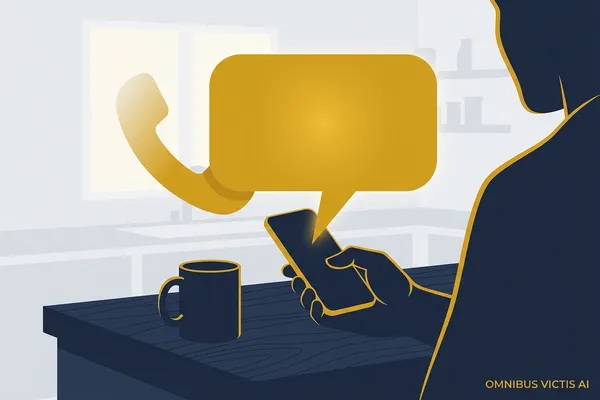
Your Customers Would Rather Text You Than Call
Quick answer: Yes, contractors should text customers, because most customers no longer answer calls from numbers they do not recognize. Pew Research found that eight in ten Americans generally ignore calls from unknown numbers, and to a new lead, your number is an unknown number. Text the people who gave you their number in the course of doing business, keep calls for the conversations that need them, and never text a purchased list.
The phone habit changed and nobody sent contractors a memo
Here is the number worth building your intake process around. In a 2020 survey, Pew Research Center found that 80% of Americans say they generally do not answer their cellphone when an unknown number calls. Only 19% pick up.
Now think about what your number looks like on a new customer's screen. You called back about their estimate request from your cell, or from an office line they have never saved. To them, you are an unknown number. You are in the same bucket as the warranty scam and the political robocall, and eight out of ten of them are letting you ring out on principle.
That is not a preference question. That is a habit that a decade of spam calls trained into your customers, and it does not care how good your work is.
What people actually do with each channel
The same Pew survey found that 67% of people will check a voicemail if you leave one. So the call is not worthless. It just got slower. Your callback becomes a voicemail, the voicemail gets checked at some point that evening, and their callback to you lands while you are under a house or on a roof. Two people who both want this job can chase each other for a day and a half without ever connecting. Every contractor knows this game of tag. Most have just accepted it as the cost of doing business.
A text skips the whole loop. It arrives silently, it gets read in a spare moment, and it can be answered from a work meeting, a school pickup line, or a couch at 9:45pm, none of which are places a person can take a phone call. In a separate study, Pew found that 97% of smartphone owners used text messaging over the course of a week. That made it the single most used feature on the phone. More than email, more than social media, more than voice.
And there is one more asymmetry that matters for trades specifically. When a customer misses your call, the natural next step is a voicemail they may or may not act on. When a customer misses your call and gets a text ten seconds later, the natural next step is a reply. The conversation survives the missed connection instead of dying with it.
What texting is actually good for
Not everything. But a specific set of messages that make up most of the traffic between a contractor and a customer:
Confirmations. "You're on the schedule for Tuesday between 9 and 11." Nobody wants a phone call for this, and nobody misses a text about it.
The on-my-way message. A text with a rough arrival time is the single cheapest thing a contractor can do to look more professional than the last guy. It also cuts the no-answer-at-the-door problem, because the customer knew you were coming.
Follow-up on a quote. A call about an unanswered estimate feels like pressure. A short text feels like service. The customer who was too busy to talk can answer in one line, and the one who went with someone else will often just tell you, which is worth knowing too.
The reply after a missed call. When someone calls you and you cannot pick up, a text that acknowledges them keeps you in the running while your competitor's voicemail box does not.
Photos. A homeowner can text you a picture of the leaking valve before you drive out. Try doing that on a voice call.
Calls still win where the conversation has weight. Diagnosing a problem, walking through a quote with real money on it, or delivering bad news about a timeline all deserve a voice. The point is not to replace the phone. It is to stop forcing every routine message through a channel most people screen.
The one line to be careful about
Everything above assumes one thing: the customer gave you their number in the course of doing business with you. They called you, filled out your form, or handed you a card. Texting those people about their own job is normal business communication, and it is what they expect.
Buying a list of phone numbers and cold texting strangers is a different activity entirely, and it sits in legal territory governed by federal law with penalties attached per message, so treat any cold texting idea as a question for a lawyer rather than a marketing tactic. I do not run cold text campaigns and will not build one.
What texting does not fix
It does not fix slow. A text that sits unanswered for six hours is the same failure as an unreturned voicemail, and maybe a worse one, because the customer can see that their message was delivered. If nobody in your shop owns the inbox, texting just gives you a faster way to disappoint people.
It does not carry tone. A blunt sentence that would sound fine in your voice can read cold in a message bubble. Keep the words plain and the sentences short, and pick up the phone the moment a thread starts to feel tense.
It does not suit every customer. Some of your best clients are 74 years old and want to hear a human being. The habit to build is simple: notice which channel each customer reaches for, and answer in kind. The goal is meeting people where they are, and for a growing share of them, that is the message thread. For the rest, it is still the phone, and that is fine.
And it does not require software to start. Your phone already texts. The automation conversation only matters once the volume does.
Where to start this week
Start with the on-my-way text. Every job, every customer, a rough arrival window sent from the truck before you pull out. It costs nothing, it takes ten seconds, and it is the message customers mention in reviews more than almost anything else.
Then look at your missed calls. Count how many came in over the past month while you were on a job, and ask what happened to each one. If the honest answer is "voicemail, and I called back when I remembered," that is the gap. A simple automatic text reply to missed calls closes it, and setting that up, along with the rules for what happens next, is part of what I build for trades businesses.
If you want to see what your own missed-call path looks like from the customer's side, book a call and we will walk through it together. Or text the office line and see how fast you hear back. Either channel works here. That is rather the point.
FAQ
Is it unprofessional for a contractor to text customers?
No. For scheduling, arrival times, photos, and quick questions, most customers now expect it. What reads as unprofessional is sloppiness inside the text: no name, no context, or a wall of abbreviations. Sign your first text to any customer with your name and company so they can save the contact.
Should I text from my personal cell or a business line?
Either works at small scale, but a business line has two advantages: customers can save one number for calls and texts alike, and the thread does not live on a phone that only one person can see. When more than one person handles customer messages, a shared line stops being optional.
Can I text people who have never done business with me?
Treat that as a legal question, not a marketing one. Texting your own customers and the leads who contacted you is normal. Cold texting numbers from a purchased list is regulated under federal law with per-message penalties, and it is a fast way to burn a business number's reputation besides.
Do customers actually prefer texts, or is that just younger people?
Preference varies by person and by situation, which is why the strongest evidence is behavior rather than opinion polls: 80% of Americans screen unknown callers, and texting is the most used feature on the smartphone across age groups. Younger customers lean harder toward text, but the screening habit is now general. Watch which channel each customer uses and match it.
Brian runs Omnibus Victis AI, working with home services businesses in Frederick, Baltimore, and the surrounding counties.

