
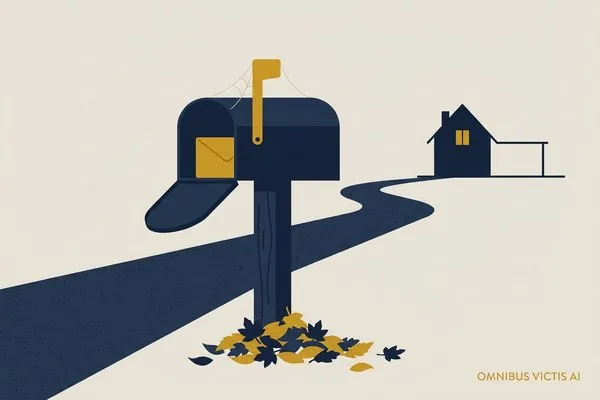
The AI Took the Message. Nobody Read It for 13 Days.
Quick answer: An answering system that captures a caller's name, number and question has done half the job. The other half is a named person getting told, every time, including when the call ends early or in a way the system did not expect. We found an existing customer whose message sat captured and unread for 13 days. Before you trust any system to take messages, check where each message lands and who gets alerted.
What happened
An existing customer called a contractor we work with. She had a question about her home. The AI answered, and she did what people do with an answering machine: she said her name, her address, her phone number and her question, then hung up.
She thought she had left a message. In a sense she had. The system wrote down what she said and saved it to her customer record. Then nothing happened. No text to the owner, no alert to the office, no task on anyone's list. She waited 13 days before anyone noticed, and we were the ones who noticed, reading back through calls in a system we were helping run.
Capture worked. Nobody was told.
Whose fault it was
Not the owner's. He had every reason to believe a message left on his line would reach him, because reaching him is the entire point of an answering system. The gap was in how the alerts were set up, and we were part of the team responsible for that.
What made it sting is who she was. A new lead who hears nothing just calls the next company, and you never find out. An existing customer who hears nothing waits. Then she starts to wonder whether you care about the work you already did for her. That is a harder thing to repair than a lost lead.
Why the alert never fired
The plain version: the system expected calls to go a certain way. A greeting, some back and forth, a proper goodbye, and then it decided who needed to know about the call. Her call never got that far. She talked, she finished, she hung up.
Because the call did not end the way the system expected, it never reached the point where someone got told. And when a call did not fit, the system's default was to stay quiet.
That default is the real lesson, and it applies to any answering setup you own, AI or not. When a system is unsure what just happened, it should tell a person. A false alarm costs the owner a minute of reading. A silent miss cost this customer almost two weeks.
A smarter AI would not have fixed it
It is tempting to look at a story like this and decide the AI was not good enough. The AI was the part that worked. It listened to a customer who thought she was leaving a voicemail, and it wrote her message down. What failed was the handoff to a human.
That matched everything else we saw on the same build. Over four weeks we logged 52 failures:
27 were wiring: something connected to the wrong place, or not connected at all.
13 were missing instructions: the system was never told what to do in that situation.
7 were fixes that did not hold.
5 were limits of the platform itself.
Zero needed a smarter AI.
If your answering system is losing customers, the first place to look is almost never the intelligence. It is the plumbing between the system and the people.
A fix on paper is not a fix
Those seven fixes that did not hold deserve their own section, because we made this mistake ourselves.
Twice, a single passing test call got written down as proof that a problem was solved. It was not. Separately, a corrected version of the instructions sat saved on our side while the live system kept answering real callers with the old one. Everyone treated the question as closed. The customer on the phone was still hearing the version nobody meant to keep.
The rule we took from it: the version your customer hears is the only version that counts. After any change, check the actual records again a day later, not just the test call that passed.
What this does not do
An alert does not call anyone back. It moves the message from the system to a person, and then the person still has to act. If the owner is already buried, a new stream of notifications can turn into one more pile he skims past.
It does not fix noisy alerts. If every robocall and wrong number pings someone's phone, people soon stop reading them, and you are back to silence by a different road. The alerts that work are the ones people trust enough to open.
And it does not mean AI answering is a bad idea. An unanswered phone would have captured nothing at all from this customer. The system did the hard part. It just never finished the job.
A self-check you can run this week
You do not need any new software for this. You need your own phone and a little time.
1. Call your own number and leave a message the wrong way. Give a name and a question, then hang up without saying goodbye. See who finds out, and how long it takes. 2. Name a person for every place a message can land. Voicemail, the AI, the web form, the text line, the email inbox. Write a person's name next to each one. If the answer for any of them is "it goes into the system," you found your gap. 3. Look back two weeks. Open your call log and your inbox and look for anyone who left a name and a question and never heard back. 4. Listen to what is actually live. If you changed your answering message or instructions recently, call in and hear it for yourself.
If that check turns up something you cannot trace, and you want a second set of eyes on where your messages go, book a call and we will follow one message from the ring to a person.
FAQ
Does an AI answering service send me every message?
Only if it is set up to. Many systems save the message to a customer record and send an alert only when the call ends in an expected way. Test it yourself by leaving an awkward, short message and seeing whether anyone is told.
Why would a caller hang up on an AI without finishing?
Some callers assume they reached voicemail, say what they need, and hang up. That is a reasonable thing to do, and your system should treat it as a real message, not an incomplete call.
How often should I check that my alerts still work?
After every change to your phone setup, and once a month even when nothing changed. Check the records a day later, not just the moment the test call ends.
Brian runs Omnibus Victis AI, working with home services businesses across Maryland.

