
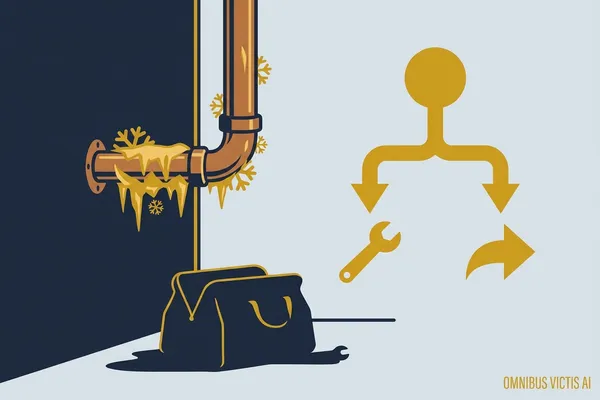
Frozen Pipe Calls: Which Ones to Take and Which to Refer
Quick answer: On the first hard freeze of the year, a Maryland plumbing shop gets a burst of calls that all sound like emergencies and mostly are not. Three intake questions sort them: is water actively leaking, can the caller find the main shutoff, and how many fixtures are out. Active water goes to the front of the line, frozen-but-intact gets booked today, and "worried about tonight" gets scheduled or pointed elsewhere. The sorting happens on the phone, before a truck moves.
The morning the phone stops making sense
The first hard freeze in Maryland usually lands sometime in November, and it does the same thing to every plumbing shop's phone. A week of quiet, then one morning with fifteen calls before 9am, every caller convinced theirs is the emergency.
Some of them are right. A pipe that split overnight and is now putting water into a finished basement is a real emergency, and it is worth more than any other call you will take that week. But on that same morning you will also hear from the homeowner whose kitchen faucet will not run but nothing is wet, the one whose upstairs bathroom works fine and only the hose bib is dead, and the one whose pipes are fine and who wants to talk about what might happen tonight.
If you treat those four calls the same, the schedule fills in the order the phone rang, which is a random order. The burst pipe gets a 2pm slot because three worried callers got there first. That is the freeze-morning failure, and it happens at intake, not in the truck.
This is a sorting problem, not a plumbing problem
To be clear about what this post is: I run an AI automation business, not a plumbing company. Nothing here is about how to thaw a pipe or what to do at the wall. That is your license and your judgment, on site. What I have something to say about is the phone, because the freeze morning is the most concentrated intake problem in the trades. One morning, one cause, wildly different urgency, and every caller using the word emergency.
The shops that come out of that morning ahead are the ones that sort fast. Not because sorting is clever, but because the alternative is first come, first served, and first come, first served on a freeze morning means your best jobs wait behind your worst ones.
Three questions do most of the sorting, and none of them require a plumber to ask.
The three questions that sort the pile
Is water actively leaking right now? This is the dividing line. A frozen pipe that has not burst is a today problem. A burst pipe with water moving is a right-now problem, and every minute matters because the damage is compounding while the caller talks to you. Anyone answering your phone, or any automated intake taking the call when nobody can, should ask this first and route on the answer.
Can you find your main water shutoff? Not "have you shut it off," just whether they know where it is. The answer tells you two things. If there is active water and they can reach the shutoff, the situation can be stabilized before your truck arrives, which changes how you sequence the morning. If they cannot find it, that call is more urgent than an identical call from someone who can. You are not walking them through repairs. You are finding out whether the clock on this one is running or paused.
How many fixtures are out? One dead hose bib on an exterior wall is a different job than a whole house with no water. The count is a rough proxy for where the freeze is and how big the visit will be, and it is a question any homeowner can answer by turning taps for thirty seconds. It also surfaces the callers who have no symptom at all yet, the "worried about tonight" group, who do not belong on today's schedule at all.
Three answers, ninety seconds, and the fifteen calls become three piles: dispatch now, book today, schedule or refer.
Which ones to refer, and why that wins
Here is the part shops resist: on the worst freeze morning of the year, you cannot serve everyone who calls, and pretending otherwise loses you the callers you most wanted.
Some calls are not yours. The burst pipe forty minutes outside your service area is a better fit for a shop out there, and holding it in your queue behind six local jobs serves nobody. The caller with no symptoms who wants reassurance about tonight may not need a truck at all this week. The frozen line in a commercial building may be outside what you do. Passing those along, with an actual name when you have one, is not lost revenue. It is the thing that keeps your schedule clear for the water-in-the-basement calls, which are the jobs that pay best and get remembered longest.
And the caller you refer remembers too. A plumber who says "that one is not us, call these guys, and call me back if they cannot get to you" reads as honest in a way no ad can buy. In a county-sized market that reputation compounds.
The refer pile only exists if intake sorts. A shop where every call lands in one voicemail box has no refer pile, just a backlog.
What this does not do
It does not fix a freeze morning by itself. If you run two trucks and twenty real emergencies land in one zip code, triage tells you which twelve calls you are going to lose, and that is genuinely useful, but it is still a capacity limit and no phone process changes it.
It does not diagnose anything. The three questions sort urgency. They do not tell you where the freeze is or what you will find when you open the wall, and an intake process that starts pretending to be a plumber is worse than one that just takes messages.
It does not have to be automated. A shop where a person answers every call on a freeze morning and asks these three questions is already doing this. Automation earns its place on the mornings when call volume outruns the people you have, which for a small shop in Maryland is a handful of mornings a year. They happen to be the highest-stakes mornings on the calendar, which is why I think the handful is worth building for, but I will concede the count is small.
Where to start
Before the first freeze, not after, write the three questions down and put them where the phone gets answered. If a person answers, they ask them in order and mark the answers. If calls roll to voicemail after hours or during the morning rush, the message or the text-back should ask the same three, so the answers are waiting in a thread instead of buried in a recording.
Then decide the refer list in advance. Which zip codes are not yours, which job types you pass along, and who you send them to. Deciding that at 7am on the cold morning, call by call, is how the wrong jobs end up on the truck.
The automated version of this, where an unanswered call gets a text asking those three questions and the answers land sorted before anyone picks up a phone, is the kind of intake work I build for trades businesses. Plenty of shops run the manual version first and only wire it up after a freeze morning proves the point. Either way, the sorting is the asset.
If you want to walk through what your intake would do with fifteen calls in two hours, book a call and we will map it before the weather does it for you.
FAQ
What counts as a frozen pipe emergency versus a same-day call?
At intake, the line is active water. A burst pipe leaking right now is an emergency because damage compounds by the minute. A pipe that is frozen but holding, with no water moving, is urgent but bookable, and a caller with no symptoms who is worried about the forecast belongs on the schedule, not the emergency list. What the situation turns out to be at the wall is the plumber's call on site.
Should the person answering the phone give advice about the pipe?
No. Intake asks questions and routes. Whether the caller can locate their main shutoff is a routing question, because it tells you if the clock is running. Anything beyond that, what to touch, what to open, how to thaw, belongs to the licensed plumber on the job, and an intake script that drifts into repair advice creates risk for the shop.
Is it really smart to refer paying callers to another plumber?
On a normal Tuesday, usually not. On a freeze morning, yes, because holding out-of-area or out-of-scope calls in your queue delays the emergencies you can serve, and those are the best jobs of the season. A clean referral also tends to come back to you as reputation, which in a local market outlasts any single ticket.
Does this require automation software?
No. Three written questions and a person who asks them cover most days. Automation matters on the mornings when calls outrun your people, when an automatic text can collect the same three answers from callers you could not pick up for. Those mornings are rare. They are also the ones where the most money is on the line.
Brian runs Omnibus Victis AI, working with home services businesses in Frederick, Baltimore, and the surrounding counties.

