
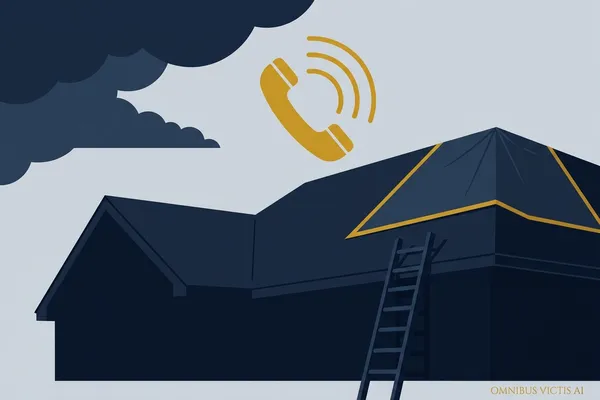
Why Roofers Lose the Most Money in the Week After a Storm
Quick answer: The week after a storm is the one week a roofer does not have a leads problem. Every homeowner with a tarp on the roof calls at once, the phone rings while the whole crew is on ladders, and the calls that go unanswered quietly go to whoever picked up. The loss never shows up in any report, because nobody counts the calls they never heard. The fix is not more leads. It is making sure every call gets an answer of some kind, even when nobody can take it.
Storm week turns the business inside out
Fifty one weeks a year, a roofing company's problem is finding work. Then a storm rolls through Frederick County, and for about a week the problem flips completely. The work finds you, all of it at once, and the question stops being how to generate leads and becomes how many of them your phone can physically absorb.
Think about what is actually happening on both ends of that phone. On the homeowner's end, hundreds of households discovered the same problem within the same few hours. A branch through the shingles, water in the attic, a lifted ridge cap. None of them planned to hire a roofer this month. All of them are now calling one, today, and they are all working from the same short list of well reviewed local companies.
On your end, storm week is also your busiest field week. Your best people are on roofs doing emergency tarps and inspections. The owner, who normally catches the phone between tasks, is driving between eight appointments. The person most able to answer is exactly the person least available.
So the biggest demand week of the year collides with your worst availability week, by design. That collision is the whole story, and it is why the money lost in storm week beats anything you lose in a slow February. In February the calls do not come. In storm week they come, and they bounce.
The loss is invisible, which is why nothing gets fixed
Here is the part that keeps this problem alive year after year: a missed call leaves no evidence.
A job you bid and lost shows up in your numbers. You remember it, you know the price that beat you, and it stings enough that you adjust. A call that rang out while you were nailing down a tarp shows up nowhere. There is no line in any report for "homeowner in Middletown who called at 2pm, got voicemail, and called the next name on the list." From inside the business, that call simply never happened.
So at the end of storm week, the books look great. Best week of the quarter, maybe the year. Everyone is exhausted and the schedule is full. Nobody stands in front of that scoreboard and asks how much bigger the number should have been, because the missing jobs never announced themselves. The full schedule is doing the work of hiding the leak.
You do not need a study to check this against your own operation. Pull up your phone system's call log from your last big storm week, if it keeps one, and count the inbound calls that never connected and never got a callback the same day. Most owners I talk to have never looked. The ones who do look are not happy about what they find.
The homeowner is not shopping. They are triaging.
It helps to be honest about what the caller is doing, because it is not what roofers assume.
A homeowner with water coming through the ceiling is not comparing three estimates the way they would for a full replacement in the spring. They are trying to get a competent person to say "we can be there" as fast as possible. They call the first company. Voicemail. They do not leave a message and wait, because waiting has a cost measured in wet drywall. They call the second company. And the moment any company answers, or even texts back with something human, the search mostly stops.
That means storm week is not really a competition on price, reviews, or workmanship. All of that mattered before the storm, because it got you onto the list they are calling from. During the week itself, the competition is almost entirely about who acknowledges the call. Being the third best roofer in Frederick with a responsive phone beats being the best roofer with a full voicemail box.
I tested this myself, from the customer's side. In July 2026 I called some of the top rated shops in Frederick the way a homeowner would, during ordinary business hours on ordinary days, no storm in sight. I did not reach a single human being. If that is the baseline on a calm Tuesday, storm week does not need to be measured to be imagined.
What actually holds up during the surge
The instinct most roofers have is to buy more leads for storm season. Storm week is the one week that instinct is exactly backwards. The leads are already calling you for free. The constraint is capture, and capture is a much cheaper fix.
Make the missed call answer itself. The simplest durable fix is a text that fires the moment a call goes unanswered. Something plain and honest: we are on roofs from the storm, reply with your address and a photo if you have one, and we will call you back in order. That message does two things a ringing phone cannot. It stops the homeowner's search, because someone has acknowledged them, and it starts collecting the information you need to triage.
Triage before you dispatch. Not every storm call is equal. A tarp emergency, an insurance inspection, and a homeowner who noticed one lifted shingle belong in different queues. If the first reply asks for an address and a photo, you can sort the day's calls by urgency instead of by the order the phone rang, which is how you stop burning your best crew hours on the least urgent visits.
Decide the callback order once, before the storm. The worst time to design a process is during the surge it was needed for. A one page rule written in the calm months, covering who watches the incoming thread, what counts as an emergency, and how fast a callback is promised, will outperform any amount of storm week heroics.
None of this requires an office manager you do not have. A missed call text with a triage question is a small build, and it is the kind of thing I set up for trades businesses. Plenty of shops could wire a rough version themselves inside the phone tools they already pay for. Either version beats a voicemail greeting recorded in 2019.
What this does not do
It does not create capacity. If every crew is booked for three weeks, capturing forty more storm calls gives you forty more people to disappoint unless you tell them the truth about timing up front. The honest version of the text back includes the wait, and the homeowners who cannot wait will go elsewhere. That is fine. They were never your job.
It does not filter out the storm chasers' leftovers. After a big Maryland storm you will still get calls from people burned by an out of state crew that knocked on their door, and some of those situations are messes you may not want.
And it does not replace insurance knowledge, estimating skill, or good work on the roof. Answering the call only wins you the chance to do everything else right. It is the cheapest link in the chain, which is exactly why it is the one worth fixing first.
Where to start
Do one thing before the next storm, and do it this week while the weather is quiet: call your own company's number from a phone you do not own, at 2pm on a workday, and see what a homeowner would experience. Then check whether your last storm week left a call log, and read it.
If what you find is a phone that rings into silence, that is the leak, and it is fixable before the next front comes through. If you want a second set of eyes on it, book a call and we will walk through your intake the way a storm week caller would experience it.
FAQs
Should I buy storm damage leads in Maryland?
During the actual storm week, probably not. That is the one week homeowners are calling roofers directly and in volume, so paid leads compete with free ones you are already failing to capture. Fix the capture first. Lead buying is a separate decision for the slow months, and it has its own tradeoffs.
Is an answering service better than an automatic text back?
A good answering service is the best experience for the caller, and it costs the most. The text back is cheaper and works for the majority of storm calls, because what the homeowner needs first is acknowledgment and a place to send photos. Some shops run both, with the service reserved for the phone line they publish for emergencies.
What should the missed call text actually say?
Say who you are, admit you are on roofs, ask for the address and a photo of the damage, and give an honest callback window. Skip anything that reads like marketing. The message is doing triage, not selling.
Does this matter outside storm season?
Yes, just less visibly. The July test I ran on Frederick shops was during ordinary weather, and the phones still went unanswered. Storm week is when the cost peaks, but the leak runs all year.
Brian runs Omnibus Victis AI, working with home services businesses in Frederick, Baltimore, and the surrounding counties.

