
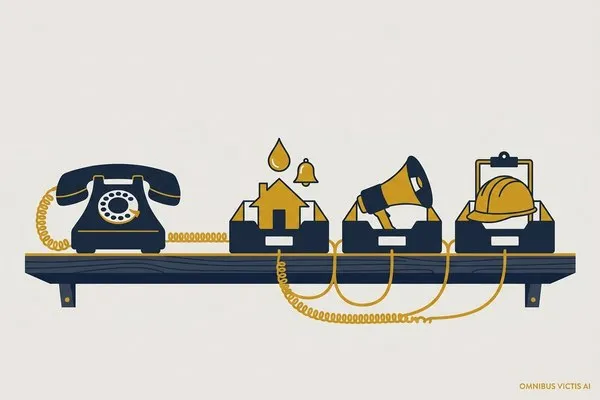
Your Phone Gets Three Kinds of Calls. Most Answering Systems Know Two.
Quick answer: Before any system answers your phone, sort your callers into three piles: customers, salespeople, and the people you work with, like adjusters, subcontractors and suppliers. Most answering setups only plan for the first two, so a partner calling about a live job gets treated like a cold pitch. Ask yourself how you actually sort calls, write it down in your own words, and decide what should happen with each kind before anything answers on your behalf.
The call that got the sales brush-off
A public adjuster called a Maryland roofing contractor we work with and asked for the owner by name. The AI answering the phone decided he was a sales call and gave him the same brush-off it gives every pitch. The call ended there.
Nothing about that was the AI being dumb. It had been set up to recognize two kinds of callers: people who want work done, and people who want to sell something. A roofer's phone gets three. The third kind, the people he works with, had nowhere to land, so the call fell into the closest pile, which happened to be the one designed to get rid of people.
That is an easy mistake to make, and it is worth five minutes of your time before you trust anything, human or software, to answer your line.
The three piles
Customers. The reason you have a phone. New homeowners, past customers with a question, people who were referred to you. This is the pile everybody plans for.
Salespeople. Marketing pitches, recorded messages, surveys, wrong numbers. This is the pile everybody wants handled, so it gets planned for too.
The people you work with. Adjusters, subcontractors, suppliers, inspectors, the general contractor who sends you work. These calls are usually tied to a job that is already moving. When one of them gets turned away, you don't lose a lead. You slow down work you already have.
Why does the third pile get forgotten? Because it doesn't feel like a category. When you know the person, you just pick up. Nobody sits down to describe "calls from people I already know" when they set up an answering system, because they never had to think about those calls before. The system only knows what someone told it, and nobody told it about the people you work with.
Ask the owner, don't guess
The second lesson came earlier, from the same roofer. When we asked him how he sorts the customer calls that come in, he gave four kinds. Everyone working on the project had assumed five or six.
A list someone drew up before asking him looked reasonable. It also invented two kinds of call he doesn't get and left out referrals entirely. Referrals are the calls where someone he already did good work for sent a neighbor his way, which is about the last call you want a system to fumble.
Here is the part worth sitting with. That guessed list wasn't silly. It looked like what a roofing company's calls should be. That is exactly what made it dangerous: it was plausible enough that nobody would have caught it without asking the one person who actually answers the phone.
If you run the business, you are that person. Your sorting, in your words, is the only version that counts.
Some calls belong in two piles at once
Water is the clearest example. A homeowner who noticed a stain on the ceiling and wants someone to come look is a normal booking. A homeowner with water coming through the ceiling right now is an emergency. Same subject, completely different call.
One question splits them: is water coming in right now?
If an answering system treats "water" as one flat category, it fails one way or the other. Either every old stain gets handled like a fire, or the active leak gets an appointment for sometime next week. Both cost you, and the second one costs you a customer who will remember exactly how it felt.
Every trade has its own version of this. A furnace that needs a tune-up and a house with no heat. A slow drip and a pipe that just let go. The topic is the same; the urgency is not. The fix is knowing the one question that tells them apart, and making sure whoever answers your phone asks it.
A sorting exercise you can do this week
If this is a slow holiday week, good. You can start this one from memory with a cup of coffee.
1. Write down the three piles on one sheet of paper: customers, salespeople, people you work with. 2. Under customers, list the kinds of calls you get, in your own words. Describe them the way you'd explain them to a new office hire on day one. Count them. If you land on a round number like five or six, be suspicious and check again. 3. Under people you work with, write actual names. Your adjusters, your subs, your suppliers. If any of them called tomorrow and asked for you, they should get through or get a fast callback. 4. Circle any call that can be routine or urgent. Next to it, write the one question that tells the two apart. 5. Next week, check the sheet against real calls. Mark each call as it comes in. Anything that doesn't fit a pile is a pile you forgot.
That sheet is worth having whether you ever automate anything. It is also the first thing any answering service, person or software, should be handed.
What this does not do
Sorting your callers doesn't make an answering system good. It is the floor. A system can know all three piles and still be wired so that nobody hears about the call that matters.
It doesn't tell you what to buy, or whether to automate your phone at all. Some owners finish this exercise and decide they want a person on the line, and that can be the right call.
It won't cover every caller. New kinds of calls show up, and no list is complete. Whatever answers your phone needs a plan for the call that fits no pile, and that plan should end with a human hearing about it.
And it is no substitute for calling your own line as each kind of caller before a real customer does.
A quick self-check
Answer these three without looking anything up:
If your best adjuster or sub called right now and asked for you by name, what would happen?
If a homeowner called at 7pm saying water is coming through the ceiling, who would know, and how fast?
When did you last write down how you sort the calls you get?
If you had to guess on any of them, that's the gap to close before anything else answers your phone for you.
FAQ
What kinds of calls does a contractor's phone get?
Three broad kinds: customers, salespeople, and the people you work with, like adjusters, subcontractors and suppliers. Within customers, the kinds of calls are specific to your business, and the owner is the only reliable source for that list.
Why do answering systems treat partners like sales calls?
Usually because nobody described that kind of caller when the system was set up. If a system only knows "customer" and "not a customer," anyone who isn't booking a job can end up treated like a pitch.
How should an answering system handle a call that is both routine and urgent?
It needs one clear question that separates the two, like asking whether water is coming in right now. The answer decides whether the call becomes a normal appointment or an emergency someone hears about immediately.
Brian runs Omnibus Victis AI, working with home services businesses across Maryland.

