
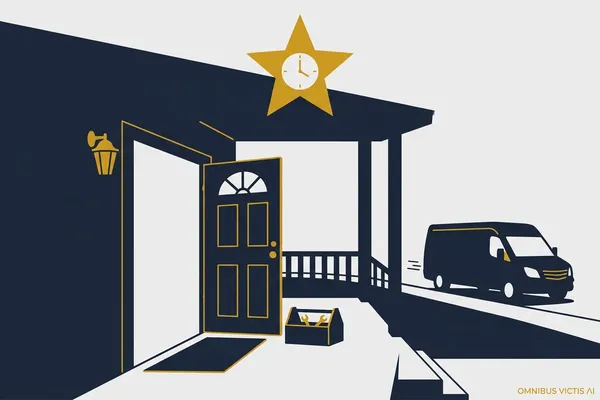
The Right Time to Ask a Customer for a Review
Quick answer: Ask at the moment the customer sees the finished work and reacts to it, which usually means the final walkthrough, and send the actual review link the same day. Do not tie the ask to the invoice, because payment is the low point of the customer's experience. Send one reminder a few days later if nothing happens, then stop.
The ask is a timing problem, not a wording problem
Most advice about contractor reviews obsesses over the script. The wording matters less than owners think. The same sentence gets a review at 4pm on the day the deck is finished and gets ignored the following Tuesday.
Here is the version of this that shows up in the wild. A contractor finishes a job on Friday. The office sends the invoice Monday. Somewhere in that invoice email, below the payment link, is a line asking for a review. The customer pays, files the email, and never thinks about it again. The contractor concludes that customers do not leave reviews, when what actually happened is that the ask arrived stapled to a bill, three days after the customer stopped feeling anything about the work.
So put the wording aside and get four decisions right instead: which moment, what the ask is tied to, which day, and how many reminders.
Ask at the moment of demonstrated satisfaction
Every job has a point where the customer sees the finished work and reacts. On a remodel it is the walkthrough. On a roof it is standing in the driveway looking up. On a landscaping job it is the customer coming out the back door while the crew loads the trailer. Someone says "this looks great" or "you cannot even tell where the leak was."
That reaction is the review. It is already written, in the customer's own words, at the exact pitch of enthusiasm a stranger reading Google will find believable. Your whole job is to catch it before it fades.
Which means the person on site is the one who should raise it. Not with a pitch. With one sentence: "If you are happy with how this came out, a Google review helps us more than anything else, and I will text you the link so you do not have to hunt for us." Said out loud, by the person who did the work, in the moment the customer just praised it.
If your jobs do not have a walkthrough, that is worth fixing for its own sake. Walking the customer through what was done is where the value of the work becomes visible, and it is also the only reliable place the ask can live.
Ask when the work is finished, not when the bill goes out
A lot of shops send the review ask with the invoice, often because their invoicing software offers it by default. Understandable, and wrong.
Think about what the customer is feeling at each moment. When the job is finished, they are looking at a new kitchen. At invoice, they are looking at a number. Payment is the single worst emotional moment in the entire relationship to ask for a favor. Even a delighted customer is, at that instant, thinking about the money. Attach your ask to it and you tint the review, if you get one at all.
There is a plainer problem too. In most shops the invoice lags the work by days. A review ask riding on the invoice inherits that lag automatically, so the ask arrives late and it arrives next to a bill. Wrong moment, wrong company.
The fix is to send the link when the work is finished, not when the bill goes out. Done right, the text with the link can be on the customer's phone before the van reaches the corner. The two work best together: the person on site raises it, and the text makes it a ten-second task.
Same day beats next week, and one reminder is the ceiling
Enthusiasm decays fast, not because the customer stops being satisfied, but because the job stops being the thing they are thinking about. By next week your beautiful patio is just the yard again. A review written in that state, if it comes at all, reads like "Good work, on time." True, and worth little. The same customer on day one writes three sentences about the crew by name.
So the link goes out the same day the work is done. Not with the invoice on Monday, not in a monthly batch the office sends when someone remembers. Same day, ideally within the hour.
Then one reminder, three or four days later, for the people who meant to and got busy. That reminder recovers a real share of the asks.
After that, stop. The second reminder gets almost nothing, and the third turns a happy customer into an annoyed one. You are also near the edge of what Google tolerates: their maps policy allows asking customers for reviews but draws the line at incentives and at soliciting in bulk. Two touches per job, both tied to actual work you just did, sits comfortably inside that. A nagging sequence does not, and it costs you goodwill even where it costs you nothing else.
While you are at it: never offer a discount or a gift card for a review. That one is not a judgment call. Google prohibits it, and you do not need it if your timing is right.
What this does not do
Timing does not manufacture satisfaction. If the job ran three weeks late and the site was left a mess, asking faster gets you a bad review faster. The walkthrough moment only works when the reaction you are catching is a good one, and the crew on site can tell. When it is not, skip the ask and fix the problem. That customer, handled well, can still review you later. Handled badly, they will review you without being asked.
It also does not rescue a profile with deeper problems. If your Google listing has the wrong hours, no photos, and two unanswered one-star reviews from 2023, new reviews help less than you would hope. Answer what is sitting there first.
And I will not pretend to give you a conversion percentage. Ask rates vary with trade, customer, and how the ask is made, and any specific number I quoted here would be invented. The honest claim is directional: the same ask, moved from the invoice to the walkthrough and from next week to same day, gets you more reviews from the same customers. The mechanism is the whole argument, and you can test it on your next ten jobs without believing a single statistic.
Frequently Asked Questions
Should the crew ask in person or should the office send a text?
Both, in that order. The in-person sentence at the walkthrough does the persuading, and the same-day text does the logistics. Either one alone works less well: a text with no human moment behind it is easy to ignore, and an in-person ask with no link means the customer has to go find you on Google, which most never do.
What if we already sent the ask with the invoice for years?
Then you have a before-and-after test sitting in your own records. Count the reviews from your last thirty invoiced asks, send the next thirty on the day the job is finished, and compare. Your own number beats anything a blog can tell you.
Is it worth asking customers from jobs we finished months ago?
Once, yes, as a one-time cleanup, aimed at the customers you know were happy. A short personal note works better than a blast here, because the moment is long gone and the relationship is all you have left. The system you build should be for the jobs you finish from now on.
How do we ask without sounding pushy?
Anchor it to their reaction, not your need. "If you are happy with how this turned out" puts the customer's judgment first and gives them a graceful way to decline. Pushy is mostly a timing smell anyway: the same words feel natural at the walkthrough and feel like pressure when they arrive with a bill or for the third time.
Where to start
Take your last ten completed jobs and write down when the review ask actually went out, if it went out at all. Most owners find the answer is "with the invoice" or "never," and either one explains a thin review page better than any theory about customers not leaving reviews anymore.
Then change one thing on the next job: have whoever is on site say the sentence at the walkthrough, and send the link before dinner. Having the link go out on its own after every finished job is the version that survives a busy season, and it is the kind of thing I build for trades businesses. But the timing is the fix, and you can start using it tomorrow.
If you want to trace where your own asks are going out today, book a call and we will walk through it.
Brian runs Omnibus Victis AI, working with home services businesses in Frederick, Baltimore, and the surrounding counties.

